
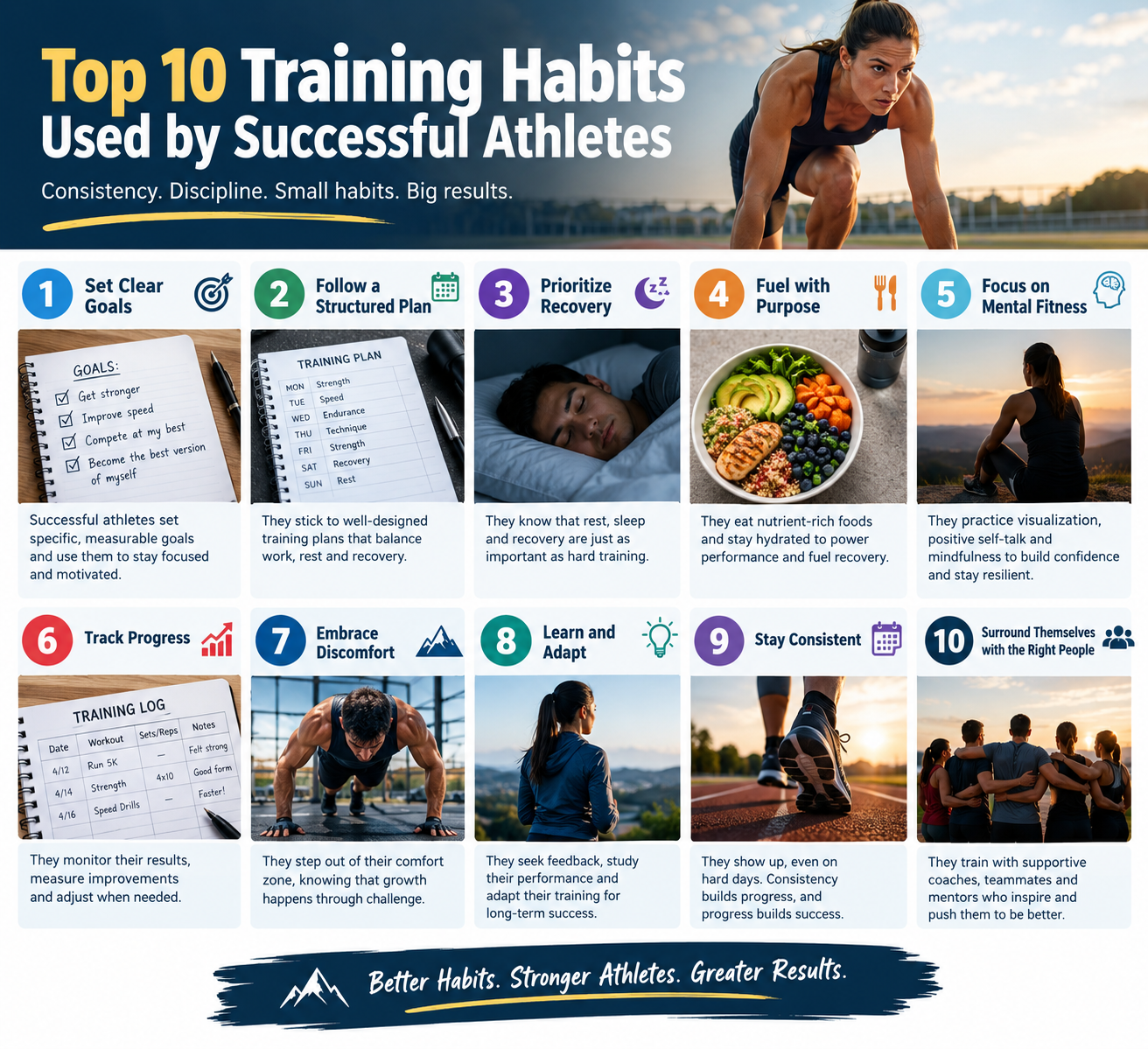
Top 10 Training Habits Used by Successful Athletes
What separates successful athletes from people who simply train hard? Often, it is not one extraordinary workout. It is the consistency of the habits surrounding training: preparation, recovery, nutrition, sleep, monitoring, and the willingness to adjust when the body or performance demands it.
Successful athletes also understand an important principle: training is a process, not a single event. The goal is to apply the right stimulus, recover from it, adapt, and gradually become better.
Below are the Top 10 training habits commonly found in effective athletic programs. These habits can apply across many sports, although the exact workload and exercises should always be adapted to the athlete, sport, training age, and competition schedule.
1. They Train With a Clear Purpose
The best athletes rarely enter a training session without knowing what they are trying to improve.
A session may target:
- Maximum strength
- Speed
- Power
- Endurance
- Mobility
- Technical skill
- Tactical decision-making
- Sport-specific conditioning
- Recovery
This approach is more useful than simply trying to make every workout exhausting.
For example, a sprinter may prioritize acceleration and maximal velocity, while a distance runner may devote more training time to aerobic development and running economy. A football player may combine strength, speed, technical drills, tactical work, and repeated-sprint conditioning.
The habit: Before training, identify the primary objective and make the exercises support that objective.
2. They Follow Progressive Training
Progressive training means gradually increasing or adjusting the training stimulus as the athlete adapts.
Progression does not always mean adding more weight. It can involve:
- Increasing resistance
- Adding repetitions
- Increasing training volume
- Improving movement quality
- Increasing running speed
- Reducing recovery time when appropriate
- Increasing technical difficulty
- Performing the same workload more efficiently
Current resistance-training guidance from the American College of Sports Medicine emphasizes that training should be tailored to the individual’s goals and that consistency is fundamental.
A common mistake is trying to progress too quickly. Successful athletes generally build capacity over time rather than treating every session as a test of maximum ability.
The habit: Make gradual, measurable progress instead of constantly chasing harder workouts.
3. They Practice Sport-Specific Skills Repeatedly
Physical fitness alone does not make an athlete successful.
A basketball player needs shooting, passing, dribbling, defensive movement, and decision-making. A swimmer needs efficient technique and stroke mechanics. A tennis player needs serving, footwork, groundstrokes, and tactical awareness.
This is why successful athletes devote significant time to deliberate skill practice.
The objective is not simply to repeat movements. Athletes should pay attention to technique, receive feedback, identify weaknesses, and progressively practice situations that resemble competition.
The habit: Rehearse important skills consistently and make practice increasingly relevant to actual competition.
4. They Treat Recovery as Part of Training
Recovery is not the opposite of training. It is part of the training process.
Hard exercise creates a physical stimulus. The body then needs adequate recovery to repair and adapt.
Effective recovery habits can include:
- Rest days
- Lower-intensity sessions
- Adequate nutrition
- Hydration
- Quality sleep
- Appropriate workload management
- Mobility or light movement when useful
ACSM notes that elite performance programs combine physical preparation with adequate rest, while recovery involves factors such as nutrition, sleep, and appropriate activity.
An athlete who continually adds training without allowing sufficient recovery may accumulate excessive fatigue and see performance decline.
The habit: Plan recovery with the same seriousness as workouts.
5. They Prioritize Quality Sleep
Sleep is one of the simplest training habits and one of the easiest to underestimate.
During sleep, the body and brain undergo important restorative processes. For athletes, inadequate sleep can affect areas such as reaction time, endurance, speed, decision-making, mood, and perceived effort.
Successful athletes often create consistent sleep routines rather than relying only on catching up after particularly hard sessions.
Useful habits include:
- Keeping relatively consistent sleep and wake times
- Creating a relaxing pre-sleep routine
- Limiting factors that interfere with sleep
- Managing caffeine timing
- Using naps strategically when appropriate
- Planning for sleep disruption during travel
Sleep requirements vary between individuals, so there is no single number that guarantees optimal performance for everyone.
The habit: Treat sleep as part of athletic preparation, not as leftover time after training.
6. They Fuel Training Properly
Training places demands on the body, and food provides the energy and nutrients needed to meet those demands.
A well-planned athletic diet generally needs to provide adequate energy while supplying appropriate amounts of carbohydrate, protein, fat, vitamins, minerals, and fluids. The exact requirements depend on the athlete, sport, body size, training load, and goals.
Carbohydrates can be particularly important for fueling many forms of intense or prolonged exercise, while adequate protein contributes to muscle maintenance and adaptation. Hydration is also important because significant dehydration can impair performance.
Successful athletes therefore do not simply ask, “What should I eat?” They consider what their training actually requires.
The habit: Match food and fluid intake to training demands rather than treating nutrition as an afterthought.
7. They Monitor Their Performance
Successful athletes need feedback.
That feedback can come from formal testing or simple daily observations. Depending on the sport, athletes and coaches may track:
- Training volume
- Running times
- Lifting loads
- Heart rate
- Repetitions
- Distance covered
- Technical performance
- Competition results
- Sleep
- Perceived fatigue
- Muscle soreness
- Training intensity
Modern technology can also help athletes monitor sleep, recovery, training intensity, and movement patterns.
However, more data does not automatically mean better coaching. The information needs to be interpreted and used to make sensible decisions.
The habit: Measure useful performance indicators and use the results to guide future training.
8. They Adjust Training Instead of Following a Plan Blindly
A training plan is a guide, not a contract.
An athlete may arrive at practice tired after a difficult competition, experience unexpected soreness, become ill, or simply perform below normal. In such situations, repeating the originally planned workload may not be the smartest decision.
Effective coaching involves adjusting training according to the athlete’s current condition and longer-term objectives.
This can mean:
- Reducing volume
- Lowering intensity
- Changing an exercise
- Adding recovery
- Modifying technical work
- Postponing a demanding session
This principle is particularly important during periods of high competition or travel.
The habit: Follow the plan when appropriate, but adjust it when evidence shows that adjustment is needed.
9. They Train the Mind as Well as the Body
Athletic performance involves concentration, emotional control, confidence, decision-making, and the ability to respond to mistakes and pressure.
Mental training can include:
- Visualization
- Goal setting
- Breathing techniques
- Pre-performance routines
- Self-talk
- Mindfulness
- Pressure practice
- Post-performance reflection
Mental skills can also be incorporated into normal training rather than treated as a completely separate activity. ACSM has highlighted the growing use of pressure-based training and psychological skills within athletic development.
The goal is not to eliminate nervousness or mistakes. Instead, athletes learn how to respond effectively when those situations occur.
The habit: Practice psychological skills before competition pressure makes them necessary.
10. They Stay Consistent for the Long Term
Perhaps the most important habit is consistency.
An athlete does not become stronger, faster, or more skilled because of one exceptional workout. Improvement generally comes from repeatedly completing appropriate training, recovering, learning from feedback, and making adjustments over months and years.
This is also why unnecessarily complicated programs are not automatically better. ACSM’s 2026 resistance-training guidance emphasizes that sustainable, consistent training is central to obtaining results.
A simple program followed consistently can be more valuable than an impressive program that an athlete cannot maintain.
The habit: Build a training routine that can be sustained long enough to produce meaningful adaptation.
The 10 Training Habits at a Glance
| Rank | Training Habit | Main Purpose |
|---|---|---|
| 1 | Train With a Clear Purpose | Gives every session a defined objective |
| 2 | Follow Progressive Training | Gradually develops physical capacity |
| 3 | Practice Sport-Specific Skills | Improves technical and tactical performance |
| 4 | Prioritize Recovery | Allows adaptation and helps manage fatigue |
| 5 | Prioritize Sleep | Supports physical and cognitive recovery |
| 6 | Fuel Training Properly | Provides energy and nutrients for training |
| 7 | Monitor Performance | Provides feedback for better decisions |
| 8 | Adjust Training | Matches workload to the athlete’s condition |
| 9 | Train the Mind | Improves focus and performance under pressure |
| 10 | Stay Consistent | Turns individual sessions into long-term development |
Final Takeaway
The best training habits used by successful athletes are not necessarily the most complicated ones. They are the habits that consistently support high-quality training over time.
A strong athlete’s routine often follows a simple cycle:
Plan → Train → Recover → Evaluate → Adjust → Repeat.
The specific exercises, workload, nutrition, and recovery strategy should differ by sport and individual. But the underlying principle remains the same: train with purpose, recover intelligently, measure progress, and remain consistent.
That combination gives athletes a much stronger foundation for long-term performance than simply trying to train harder every day.